

The 7 best positioning and brand strategy agencies for B2B SaaS in 2027
Seven agencies and consultancies that help B2B software companies sharpen their positioning, what each one is built for, and what to ask before signing anything.

Positioning decides whether a buyer gets what you do, which companies your product is built for and why it’s a better choice than the other options. It’s also one of the hardest calls to make from the inside because everyone in the room knows the product too well and the market (usually, that is) not well enough.
AI search only raises the stakes. In G2’s 2026 research among 1,076 B2B software buyers, 51% said they now start their research with an AI chatbot more often than with Google. And 69% ended up choosing a different vendor than they first planned, simply because that vendor appeared in the chatbot’s recommendation.
The issue is when your positioning is vague, the summary an AI gives of you will be vague too. That's when a positioning and brand strategy agency can help.
The agencies below range from two-week homepage sprints to multi-month rebrands and fractional product marketing teams. Rather than ranking them on one scale, we paired each agency with the type of business it suits and flagged who should skip it.
Agencies and consultancies were selected for their B2B software focus, positioning work they deliver themselves, published client results, independent reviews, and whether scope and price are published. No agency paid to be included.
Which positioning agency fits your company?
Use this table to find the two or three agencies closest to your situation, then read their sections in full.
| # | Agency | Best for | Based in |
|---|---|---|---|
| 1 | Unmuted | Complex SaaS products that need positioning and rollout from one team | Amsterdam, Netherlands |
| 2 | Fletch PMM | Software teams that want a fast, fixed-price homepage positioning sprint | Chicago and Austin, US |
| 3 | Focus Lab | B2B tech companies ready for a full rebrand | Remote, US |
| 4 | STFO | Established B2B companies that want senior-only positioning, brand and go-to-market work | Dublin, Ireland |
| 5 | Genesys Growth | SaaS startups that need senior product marketing before they hire | Essex, UK |
| 6 | Olivine Marketing | Teams that need ongoing, fractional product marketing | San Francisco, US (remote team) |
| 7 | Ramotion | SaaS companies that need naming and visual identity | San Francisco, New York and Los Angeles, US |
1. Unmuted: best for complex SaaS products that need positioning and rollout from one team

This entry is about us. Unmuted is the Amsterdam B2B agency that publishes this blog, so read this section with that in mind. We work with B2B SaaS companies that sell complex products with long sales cycles.
Our positioning work runs as a four-week sprint. Week one is research: search demand data, two to three customer conversations, won and lost deals, a map of the competitive alternatives and a check of how AI search describes you today. In two workshops, the team then decides who you’re for and which category you compete in, picks one of four differentiation routes with the trade-offs written down, and builds a messaging hierarchy. On week four, we rewrite your homepage and scan your website, help center and third-party listings for messaging that still tells the old story.
We recommend bringing no more than four to six people to this process. The sprint starts at €8,000 for companies under €10M ARR and at €16,000 above that, where it adds multi-segment or multi-product positioning, wider stakeholder alignment and a cross-channel launch plan.
At EffectConnect, we started with a positioning workshop, then rebuilt their HubSpot sales pipeline and aligned their website and campaigns with the new positioning. In under four months, sales cycles got 60% shorter and the average deal size was 57% higher. At Starred, the positioning workshops in the first weeks became the foundation for the rest of the marketing work we carried out.
Because positioning is also a part of The Growth Program, the same team can carry the new story into content, video, your website and paid campaigns afterwards.
“We had been trying to say too much, which made the story harder to follow. With Unmuted, we finally were able to make some hard choices and become focused on who we target and what we tell them. Now, the message resonates throughout the entire journey.”
Bart Vintcent, Founder of EffectConnect
Choose Unmuted if:
- Your product has a high ACV and a long sales cycle
- You want research, workshops, messaging and a homepage rewrite in one fixed four-week project
- You want the team that defined your positioning to roll it out across channels
Not the right pick if:
- Your main need is a new name or visual identity rather than new positioning
- You don’t have customers or closed deals to learn from yet, since the research starts there
2. Fletch PMM: best for software teams that want a fast, fixed-price homepage positioning sprint

Fletch PMM is a product marketing firm operating out of Chicago and Austin for B2B software companies at any stage. Its offer is deliberately narrow: a two-week homepage positioning sprint, run as live Zoom workshops with revisions in between.
You get four to six positioning options ranked by risk, a short internal deck to align the team and a homepage wireframe with draft copy. Fletch doesn’t interview your customers. Its FAQ explains that your team is the expert on its own buyers, so you bring four to six people who know them well. Sales decks and other assets aren’t part of the work.
Pricing is published and depends on company size: $10,000 for early-stage companies (under $2M in revenue or total funding), $20,000 between $2M and $20M, and $30,000 above that. When we checked, the site mentioned a wait of two to six weeks before a sprint can start.
Client stories on its site include Mav, which reported 54% ARR growth over about a quarter and a half after moving to a vertical positioning, and Candix, which went from 2 to more than 40 clients in six months, all inbound. We found no independent reviews on Clutch or G2.
Choose Fletch PMM if:
- Your homepage is where your positioning falls apart
- You want a fixed price and a two-week timeline
- Your team knows its customers well enough to work without outside interviews
Not the right pick if:
- You’d rather have customer interviews done for you
- You need sales enablement, a rebrand or launch support in the same project
3. Focus Lab: best for B2B tech companies ready for a full rebrand
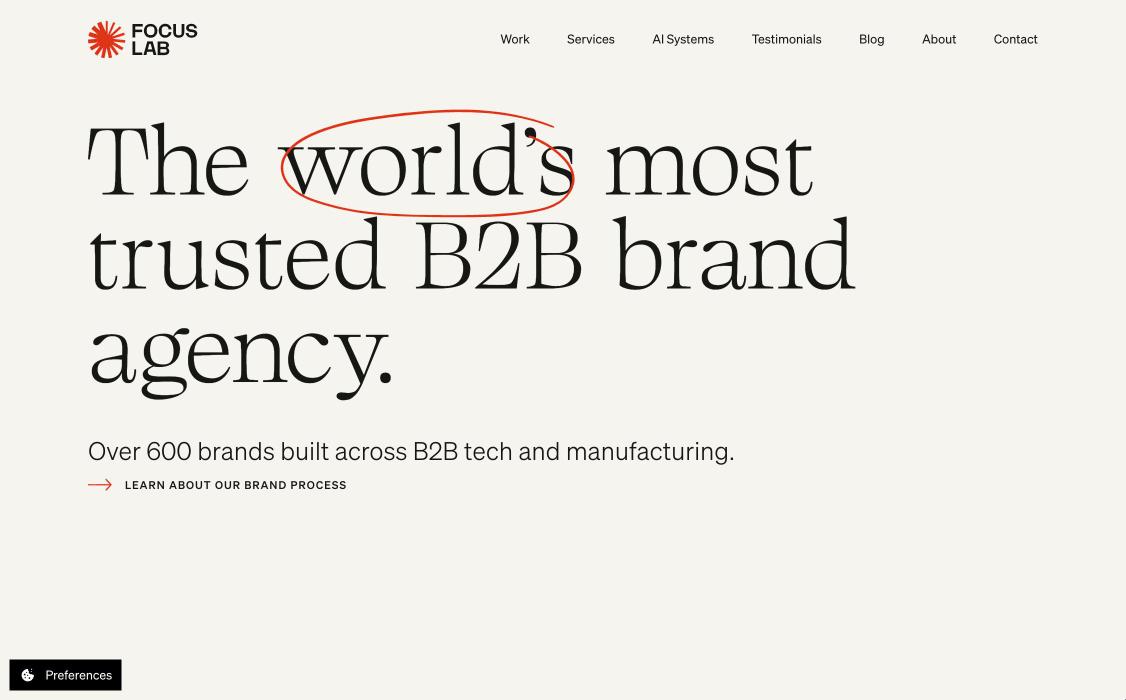
Focus Lab describes itself as a US-based B2B brand agency for tech and manufacturing companies and its whole team works remotely. Most of the clients it names are software companies, including Braze, LaunchDarkly, Customer.io, Salesloft and Zuora. Its services cover brand strategy, verbal and visual identity, web design and brand activation.
Focused branding engagements start at $15,000 a month and usually run for one to three months. Structural rebrands start at $25,000 a month and run for three to five months. Early-stage startups can book a six-week branding sprint and ongoing retainers start at $5,000 a month. Those retainers can be stopped monthly and carry a 30-day money-back guarantee.
Focus Lab has 44 reviews on G2 with an average rating of 4.9. Much of the news on its site covers client funding rounds and acquisitions rather than results of its own work. The one brand outcome it highlights is Flute, which it says captured 12.5% share of voice within weeks of its rebrand.
Choose Focus Lab if:
- You need positioning, a new identity and a website as one project
- You have the budget and time for a rebrand that runs several months
- You want to see pricing before the first call
Not the right pick if:
- You only need sharper messaging, not a new brand
- You want customer research or sales enablement at the center of the work since neither is listed as a service
4. STFO: best for established B2B companies that want senior-only positioning, brand and go-to-market work

STFO is a positioning, brand and go-to-market consultancy in Dublin, founded by Louis Grenier. It works with established B2B companies “facing existential threats” with two senior partners running every engagement and no handoff to junior staff.
They have one offer: an eight-week GTM Sprint. It starts with customer research (interviews, sales recordings, reviews), moves to a positioning decision and a sharper brand, and ends with a campaign in market. STFO says it doesn’t do full rebrands; it works with the brand you have. Pricing is published by revenue band: €20,000 below €1M, €40,000 between €1M and €20M, and from €60,000 above that. Under its “Week-3 Walkaway” guarantee STFO states you get the insight brief after three weeks and can stop there without paying anything further.
Louis Grenier has advised software companies such as Dropbox, Hotjar, Ahrefs and Balsamiq. The case studies on STFO’s site report 40% more qualified trial signups for Balsamiq after the sprint. The results with a time frame attached, for 900.care and PTDC, come from businesses outside software. We found no third-party reviews.
Choose STFO if:
- Your market has shifted and positioning and go-to-market need rethinking together
- You want senior people in every session
- You want a clear exit point if the work isn’t landing
Not the right pick if:
- You need a quick fix, since the sprint takes eight weeks
- You need a full rebrand with a new identity; STFO clearly states it doesn’t do those
5. Genesys Growth: best for SaaS startups that need senior product marketing before they hire

Genesys Growth is a product marketing and content consultancy for Series A+ B2B SaaS, run by Matteo Titta from Essex in the UK. The site is written in the first person and you book calls with Matteo directly. Customers it lists include Toast, Strapi, Ahrefs, AirOps and Common Room.
Its main service is aimed at Series A to C startups that are hiring for a senior product marketing or content role and can’t wait for the hire. The work goes further into execution than most positioning firms on this list: win/loss, competitor and ICP research, positioning and messaging, landing pages, launches and sales enablement. It costs $9,000 a month with a three-month minimum.
Its site has a case study library with more than 30 named clients, many with results attached, such as 189% more organic clicks in two months for Zeffy. A separate testimonials page collects client quotes, but we didn’t find reviews on third-party platforms.
Choose Genesys Growth if:
- You’re hiring a senior product marketer and need the work done in the meantime
- You want positioning turned straight into landing pages and launch assets
- You prefer working directly with one senior practitioner
Not the right pick if:
- You need several people working on different workstreams at once
- You need brand identity or design work
6. Olivine Marketing: best for teams that need ongoing, fractional product marketing

Olivine Marketing is a product marketing agency for B2B tech and SaaS companies, founded in 2016. Its privacy policy gives a San Francisco address, and its Clutch profile describes a remote team spread across several continents. It says it has worked with more than 70 clients, including ServiceNow, LinkedIn, Twilio, Zuora and Darktrace.
It covers the whole product marketing stack: customer and market research, buyer personas, positioning and messaging, competitive intelligence, sales enablement, brand identity, and website design and copy. You can hire it as an agency team, bring in a fractional product marketer for 5 to 40 hours a week, or use its self-serve playbooks.
Olivine has 12 reviews on Clutch with an average of 4.9, the most recent from October 2026. Its client portfolio has around 18 case pages that describe the work and how long each partnership lasted, plus client testimonials, though most don’t include measured results. It doesn’t publish prices. Clutch lists a minimum project size of $10,000.
Choose Olivine Marketing if:
- You don’t have a product marketer yet and need positioning plus the work that follows it
- You want flexible hours instead of a fixed project
Not the right pick if:
- You want a fixed-price, time-boxed positioning project
- You want to see measured client results before you commit
7. Ramotion: best for SaaS companies that need naming and visual identity

Ramotion is a product and brand design agency with offices in San Francisco, New York and Los Angeles, and its SaaS branding page presents it as a global SaaS branding agency. Clients it names include Descript, Salesforce, Redis, Stripe and Okta.
Its service pages are specific about timing. Brand strategy and positioning takes two to eight weeks, naming and verbal identity three to eight, and visual identity four to twelve. It also designs SaaS websites.
Ramotion has 29 reviews on Clutch with an average rating of 4.9, the most recent we found from May 2025. It doesn’t publish prices on its site. Clutch lists a minimum project size of $50,000. Most of the proof on its site comes from client testimonials rather than measured results.
Choose Ramotion if:
- Your positioning is settled and your brand no longer matches it
- You need a new name, identity and website from a single studio
Not the right pick if:
- You’re still deciding who you’re for and how you’re different
- Your budget for brand work is below Clutch’s listed minimum
How do you pick the right kind of positioning help?
Start with timing. Forrester’s buyer research found that 68% of B2B buyers already have a front-runner vendor in mind at the very start of their purchase and 80% of the time that front-runner wins. Only 19% of B2B marketing leaders believe buyers have clear preferences that early. Positioning is how you become the front-runner before anyone books a call, so the type of help you hire matters.
Our colleague Iris Dings runs positioning workshops with our clients. This is her rule of thumb for picking the right kind of help:
“A short positioning sprint works when the organization is already aligned on which category they’re in, who their ICP is, what their competition is and why they win deals. In that case the sprint sharpens the positioning instead of rebuilding it. A full repositioning is needed when the team can’t agree internally on what they are, who they’re for and why they’re the best option in the market. You usually see it in the pipeline too. Sales struggles to close inbound leads, outbound doesn’t land, and the message doesn’t resonate. Ongoing product marketing help is the right fit when product marketing doesn’t exist yet, or when the team can’t turn the product into messaging and campaigns that grow pipeline.”
Iris Dings, Senior Content Marketing Manager at Unmuted
Mapped to the list above:
- Sharpening positioning you mostly agree on: a fixed sprint, such as Fletch PMM for the homepage or Unmuted for research, messaging and rollout
- A full repositioning: a longer engagement with research and senior facilitation, such as STFO or Unmuted
- A brand that no longer fits: a rebrand partner such as Focus Lab or Ramotion, once the positioning itself is clear
- No product marketing function yet: ongoing help from Olivine Marketing or Genesys Growth
Not sure positioning is the real problem? Check the six signs your pipeline problem is a positioning problem or whether you’ve hit one of the triggers that call for repositioning.
Which red flags should you look out for in a proposal?
Most positioning projects that fail don’t fail in the workshop stage. They fail in the weeks after it. Iris sees the same pattern again and again:
“The most common reason is misalignment. The wrong people were in the room, so decisions get made that the C-level doesn’t stand behind. Positioning also fails when it never turns into concrete messaging, because then nobody feels confident using it and it fades. Before signing, buyers should ask what’s included in the positioning work, which steps the agency will take, and what the follow-up looks like once the workshop is done. If that isn’t clear, you don’t know what you’re signing up for.”
Iris Dings, Senior Content Marketing Manager at Unmuted
Be careful when an agency:
- Can’t tell you exactly what you get at the end, beyond “a positioning statement”
- Has no step for customer input, either its own research or a request for your won and lost deal data
- Doesn’t ask who from your team will be in the room, or leaves out sales and leadership
- Stops at a deck, with no messaging your sales team and website can use the next week
- Pitches a visual rebrand before anyone has agreed on who you’re for
Positioning consultant, brand agency or full-service team?
The options on this list fall into three groups and each comes with trade-offs:
Positioning consultants and sprint specialists (Fletch PMM, STFO, Genesys Growth) are fast and focused, with senior people doing the work. The output is a decision and the messaging around it, sometimes with a launch campaign or new landing pages. For everything after that, from sales material to the rest of your site, you’ll often need someone else.
Brand agencies (Focus Lab, Ramotion) turn positioning into a name, identity and website. They’re the right call when the strategy is clear but the brand looks and sounds like an older version of your company. They’re a weaker fit when the real question is still who you’re for.
Full-service and product marketing teams (Unmuted, Olivine Marketing) cover positioning and the work that follows it: messaging, web, content, enablement and campaigns. You trade some of a specialist’s depth in one discipline for continuity. The people who made the positioning decisions also make sure they show up everywhere.
How do positioning agencies charge?
There are three common models:
- Fixed-fee sprints with a set scope and timeline, usually priced by company size or revenue
- Monthly fees for multi-month projects such as rebrands, where the total depends on how long the work runs
- Fractional hours for ongoing product marketing, billed per week or month
Whatever the model, ask what’s included: how much customer research, how many workshops, whether copy is written for you, how many rounds of revisions you get and what support you get after handover. Two quotes at the same price can cover very different amounts of work.
Questions SaaS teams ask before a positioning project
These are the questions we hear most often from SaaS teams before a positioning project starts.
Who should be in the positioning workshop?
Keep the group small and make sure it can decide. Iris’s advice:
“Come in with customer insights, ideally including data from closed-won and closed-lost deals. You also need deep clarity on the specific product you’re positioning, because every sub-product can have its own positioning. In the room you need product experts, sales people who talk to buyers every day, and an executive who can make decisions. If the C-level doesn’t back what’s decided in the workshop, aligning afterwards becomes slow and inefficient.”
Iris Dings, Senior Content Marketing Manager at Unmuted
Do we need a rebrand or a repositioning?
Not always both. Repositioning changes the audience you target, the alternatives you’re compared with and the reason you win. A rebrand is about your name, visual identity and tone of voice. Plenty of companies need the first without the second. We cover the difference in more detail in our article on when to reposition your SaaS product.
How long does positioning work take?
The options on this list run positioning projects from two weeks (a homepage sprint) to eight weeks (a sprint that covers go-to-market too). A full rebrand takes several months. Rolling the new positioning out across your website, sales material and campaigns usually takes longer than defining it.
Can we do positioning ourselves?
Yes, if your team already agrees on its category, its ideal customer and why it wins. Outside help adds the most when internal debates keep stalling or when nobody has the time to do the customer research properly.
Finding the right positioning partner
The right partner depends on where you are. Some teams need a sharper homepage, some a full repositioning, some a new brand, and some a product marketer they don’t have yet. Be clear on which one you need before you compare proposals and ask every agency what happens after the workshop.
If you’d like to see how we approach it, read how our positioning sprint works or book a positioning teardown.